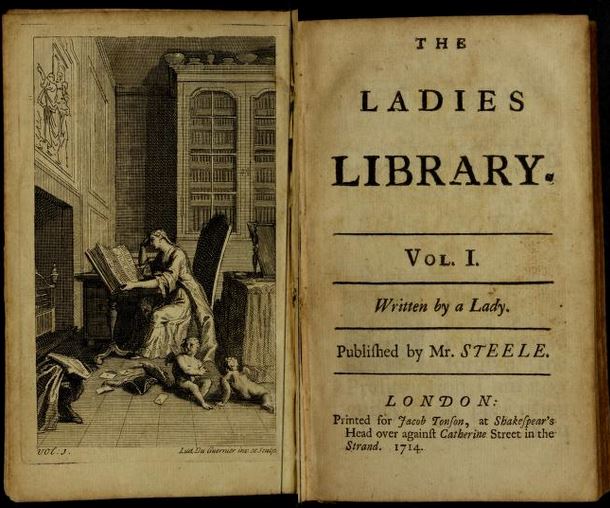
This past spring I served as a metadata intern for Project Vox, a digital scholarship project highlighting the accomplishments of early modern women philosophers. While my passion has long been outreach, I wanted to expand my knowledge during this internship and learn more about the behind-the-scenes aspects of library work. The internship provided a chance for me to re-adapt the project management skills I had used as a graduate admissions professional to the needs of a digital scholarship project. The project’s focus on women’s intellectual contributions gave me a sense of purpose and spoke to my feminist side. Digital scholarship has tremendous potential for expanding resource access to marginalized and underserved populations, so I am certain that the knowledge I gained during the internship will be put to good use in my future outreach career.
My job responsibilities were to help develop a file-naming system, write copyright assessment instructions for future student employees, and research the copyright status of the project’s website images. As a filenamer, I worked alongside an intern who was studying digital librarianship at North Carolina Central University. We used our knowledge of Dublin Core and input from project team members to co-develop a file-naming system that would meet the needs of the project researchers. Since understanding copyright law was more central to my internship goals than to my colleague’s, I did most of the copyright research independently, with the very helpful guidance of the library’s copyright consultant.
Digging through European museum websites and layers of digital folders to find image permissions data was super tedious, and, at times, overwhelming. It was also educational and somewhat fun. I got to use my French skills and apply the organizational concepts I had been taught in my library classes to a real-world problem, while learning about some influential women thinkers.
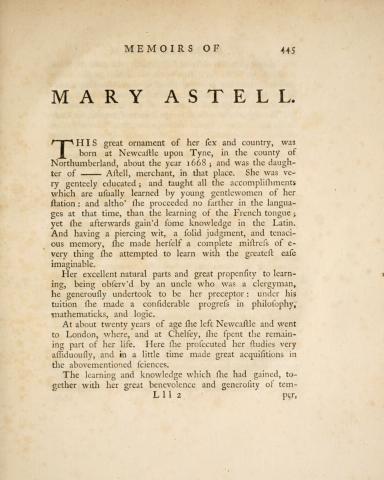
Unfortunately, my spring schedule did not leave much time for perusing the philosophers’ writings. (I actually did begin reading Du Châtelet’s Discourse on Happiness (Discours sur le bonheur) in the spring but had to put it aside when classes got hectic.) Last week, I started going through the Project Vox website content to get a better sense of what the site’s featured thinkers were actually thinking about. In the process of doing so, I came across these intriguing short videos about Emilie Du Châtelet:
Who is Emilie Du Châtelet?, Part 1
Who is Emilie Du Châtelet?, Part 2
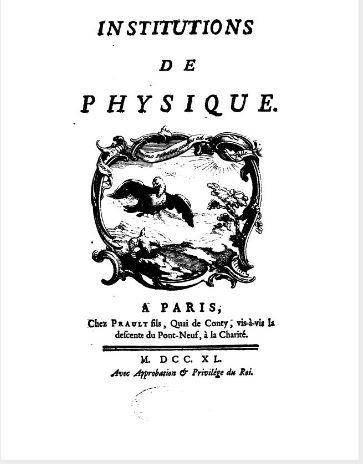
The videos are narrated by Duke University professor Andrew Janiak, Project Vox’s principal editor. In them, he mentions Du Châtelet’s association with Voltaire, her translation of Isaac Newton’s Principia Mathematica, and her authorship of Institutions de Physique (Foundations of Physics). According to Janiak, du Châtelet drew on the insights of both Newton and (Gottfried Wilhelm) Leibniz in her work during a time when many thought that these two philosophers’ ideas could not be reconciled.
Janiak’s fascination with the French thinker began while he was studying philosophy at the University of Michigan. In a 2017 piece for the Washington Post’s higher education blog, Grade Point, he recalled his reaction when he came across a reference to Du Châtelet in the 1990s while reading a text by Immanuel Kant:
“Back then, one could receive an entire college education in philosophy without reading a single text written by a woman. In fact, one could take a dozen courses without even hearing a woman’s name mentioned. And so I read Kant’s pages-long description of Madame Du Châtelet’s work, I was stunned. Who is this French woman, obviously some kind of aristocrat, whom Kant is discussing? But soon, a more depressing thought overcame me: Why haven’t any of my teachers ever mentioned Du Châtelet? For that matter, why have they never mentioned any woman who published philosophical works during the 17th or 18th centuries?”
I was an undergraduate student during Janiak’s “back then.” In fact, my decision to intern with Project Vox was driven in part by a personal and painful experience I had in the 1990s as an undergraduate political science major at Duke. Despite my good academic record, one of my male faculty advisors recommended that I not take Western philosophy because I lacked a philosophy “background.” The advisor’s lack of faith in my intellect was obvious and demoralizing. I do not know whether it had to do with my gender, my race, or something else entirely. The “no background” argument made no sense; where are you supposed to develop a philosophy background if not in an undergraduate philosophy course?
Fortunately, I ended up taking an outstanding philosophy course with a very supportive professor (who happened to be male). But I never forgot what that advisor said to me. I hurt when I think about how many other young women may have been discouraged from taking philosophy courses by some male professors who thought that they could not hack it.
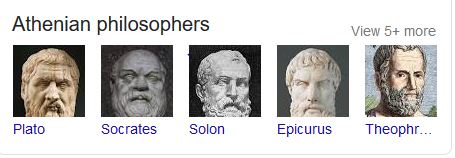
Whether due to lack of encouragement, lack of interest, or some other cause, women are clearly underrepresented among philosophy majors. In his blog, The Splintered Mind, University of California at Riverside professor Eric Schwitzgebel (2017) made the following observation based on his review of National Center for Education Statistics data:
“The percentage of Philosophy Bachelor’s degrees awarded to women has been remarkably constant over time — a pattern not characteristic of other majors, many of which have shown at least a modest increase in the percentage of women since 1987. In the 1986-1987 academic year, women received 33.6% of Philosophy BAs. In the most recent available year (preliminary data), 2015-2016, it was 33.7%. Throughout the period, the percentage never strays from the band between 29.9% and 33.7%.”
One possible explanation for the underrepresentation of females in the philosophy field is mentioned in the 2013 book Women in Philosophy: What Needs to Change? In the book’s introduction, editors Fiona Jenkins (Associate Professor, Australian National University) and Katrina Hutchinson describe the ages-old ingraining of male/female hierarchies in Western philosophical discourse:
“[W]estern philosophy was formed around an overlapping series of conceptual oppositions—reason/emotion, mind/body, culture/nature—coding a hierarchical understanding of the relationship of masculine and feminine that can be discerned throughout the 2, 500-year history of the subject.1 The gender schemas that shape the history and practise of the discipline may thus form a problematic nexus with the particular institutional forms that philosophy takes in the 21st century, including elements of its social significance, pedagogic practices, research priorities, privileged methods, and ways of engaging with feminist critique.”
“…history of the subject.1 ” The authors cite the following texts for this reference (authors’ citations preserved in their original formatting and order):
Beauvoir, Simone de (1989) The Second Sex, trans. Parshley, New York: Vintage.
Lloyd, Genevieve (1993). The Man of Reason: “Male” and “Female” in Western Philosophy, Minneapolis: University of Minnesota Press.
Le Dœuff, Michèle (1989) The Philosophical Imaginary, trans. Gordon, London and New York: Continuum.
Le Dœuff, Michèle (2003) The Sex of Knowing, trans. Hamer and Code, New York and London: Routledge.
Le Dœuff, Michèle (1990) Hipparchia’s Choice: An Essay Concerning Women, Philosophy etc., trans. Trista Selous, Oxford, UK: Blackwell.
Le Dœuff, Michèle (1989) The Philosophical Imaginary, trans. Gordon, London and New York: Continuum.
(p.19) Gatens, Moira (1991) Feminism and Philosophy: Perspectives on Difference and Equality, Bloomington, IN: Indiana University Press.
There are other possible explanations. In her piece, “Name Five Women in Philosophy. Bet You Can’t.” , Tania Lombrozo cites research done by Toni Adelberg, Morgan Thompson, and Eddy Nahmias at Georgia State University suggesting that the philosophy course content itself is an issue. In a survey of 700 male and female students who took an introductory philosophy course, the females in general
“found the course less enjoyable and the material less interesting and relevant to their lives than male students. Compared to male students, they also felt that they had less in common with typical philosophy majors or with their instructors, reported feeling less able and likely to succeed in philosophy, were less comfortable participating in class discussions and were less inclined to take a second philosophy course or to major in philosophy.”
Not everyone is convinced that the underrepresentation of women in philosophy is a problem (see the debate between philosophers Mary Warnock and Julian Baggini), but I think it is. When women’s voices are underrepresented in philosophy (or in any field) their experiences and ways of relating to the world – which are often quite different from men’s – stand the risk of being undervoiced as well. This concerns me more in philosophy than in some other fields because of philosophy’s impact on political thought and its pervasive influence within the academy. Philosophy is truly a “foundational” discipline in the humanities, cutting across many different subjects. Political science, religion, literature, and art are all replete with philosophical references. I believe the underrepresentation of women in philosophy can indirectly lead to male-dominant discourse in all of these subjects.
While Project Vox will not solve the gender gap problem, if it keeps even one woman from thinking that she cannot hack it as a philosopher, then it will have served a great purpose.
I would love to see Project Vox-type sites highlighting the work of contemporary women philosophers, particularly women philosophers of color. If you know of any such sites, please send me the links.
References
Ballard, G. (1752). Memoirs of several ladies of Great Britain, who have been celebrated for their writings or skill in the learned languages, arts and sciences. Digitized by the Internet Archive in 2011 with funding from Duke University Libraries. Retrieved from https://archive.org/stream/memoirsofseveral00ball#page/n7/mode/2up
Hutchison, K., & Jenkins, F. (Eds.). (2013). Women in philosophy: What needs to change? New York, NY: Oxford University Press.
Janiak, A. (2017, October 23). Who was that marquise? Rediscovering forgotten voices of women in philosophy. [Blog post]. Grade Point (the higher education blog of The Washington Post). Retrieved from https://www.washingtonpost.com/news/grade-point/wp/2017/10/23/who-was-that-marquise-rediscovering-forgotten-voices-of-women-in-philosophy/?noredirect=on
Schwitzgebel, E. (2017, December 8). Women have been earning 30-34% of philosophy BAs in the US since approximately forever. [Blog post]. The Splintered Mind. Retrieved from http://schwitzsplinters.blogspot.com/2017/12/women-have-been-earning-30-34-of.html
Additional Reading
Lombrozo, T. (2013, June 17). Name five women in philosophy. Bet you can’t. NPR (Cosmos & Culture). Retrieved from https://www.npr.org/sections/13.7/2013/06/17/192523112/name-ten-women-in-philosophy-bet-you-can-t
Paxton, M. , Figdor, C. and Tiberius, V. (2012). Quantifying the gender gap: An empirical study of the underrepresentation of women in philosophy. Hypatia, 27: 949-957. doi:10.1111/j.1527-2001.2012.01306.x
Warnock, M. and Baggini, J. Does philosophy have a problem with women? The Guardian. Retrieved from https://www.theguardian.com/commentisfree/2015/jul/25/philosphy-women-warnock-baggini-debate
 Stacy Torian